
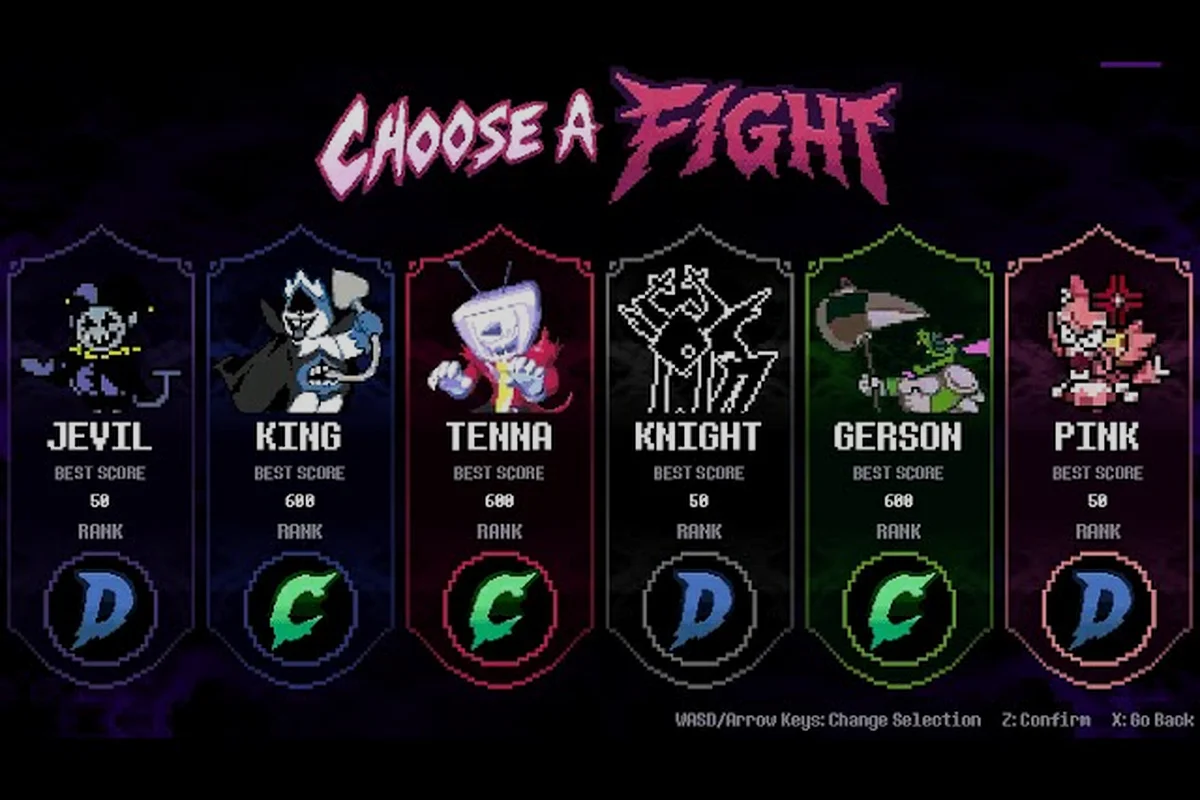
Unlocking bosses in DELTARUNE Fight is less about hidden keys and more about understanding the game's difficulty gates and phase triggers. This guide breaks down the confirmed roster, what each encounter demands, and how to read the attack patterns that separate a clean clear from a frustrating wipe.
Understanding the Confirmed Boss Roster and Unlock Flow
The confirmed line-up so far includes Tenna, King, Pink, and Kaizo Knight, according to community videos and player reports as of the September 2026 build. The game does not publish a closed roster count, so treat this as the active set rather than a final list. Each boss sits behind a progression gate that is tied to difficulty selection rather than a story flag, which means your unlock path is mostly about surviving the previous fight on a higher tier.
| Boss | Unlock Gate (Community-Reported) | Primary Pressure | Best First Habit |
|---|---|---|---|
| King | Available early on Standard | Wide, high-damage swings | Learn the arena edges |
| Tenna | Requires clearing earlier fights | Tracking volleys and screen sweeps | Keep the Soul moving in small circles |
| Pink | Unlocks after later progression | Fast, overlapping projectiles | Watch for telegraphed bursts |
| Kaizo Knight | Highest confirmed tier gate | Long, punishing final phase | Save TP for the last stretch |
Because the game is a Boss Rush style simulator, the unlock flow rewards consistency rather than exploration. Players report that simply clearing a fight once on Standard opens the next encounter, while the harder tiers exist to test mastery of the same mechanics. The key distinction is that Brutal and Genocide do not add new bosses; they intensify the existing patterns.
How Difficulty Tiers Shape the Unlock Path
The three community-reported difficulty tiers are Standard, Brutal, and Genocide. Standard is the default and the only tier where most players will first unlock each boss. Brutal and Genocide are for repeat clears and speedrun practice, and they demand that you already understand every phase trigger before you enter.
Reading Boss Phases and Attack Pattern Logic
Every confirmed boss in DELTARUNE Fight shifts behavior at health thresholds, although the exact trigger points are not published. Community videos show that phase changes are announced by a visual tell or a brief pause, which gives you a short window to reposition the Soul. The core skill is recognizing which attack family is coming next: a screen-wide sweep, a tracking volley, or a telegraphed burst.
| Phase Signal | What It Usually Means | Recommended Response |
|---|---|---|
| Brief pause and color shift | New attack family incoming | Move to the arena center |
| Boss moves to a corner | Screen-wide sweep setup | Hug the opposite wall |
| Projectiles fan out | Tracking volley begins | Circle the Soul, do not stop |
| Rapid flashing | Final phase burst | Spend TP on a defensive or burst option |
The only named attack that appears in community videos is Rude Buster, which players report can skip the final stretch of certain fights when timed correctly. Because the game publishes zero mechanic numbers, every timing here is qualitative: a short window, a long stretch, or a telegraphed well in advance cue. That is why learning the visual language of each boss matters more than memorizing a damage rotation.
Why the Soul Is Your Real Health Bar
During bullet phases, you steer the Soul — the heart-shaped cursor — through gaps in each pattern. The Soul is your actual survival tool, and every boss attack is really a test of how smoothly you can path through overlapping projectiles. Players report that panic movement causes more wipes than raw difficulty, because a sudden direction change often carries you into a second hit.
Confirmed Boss Breakdown and Fight Habits
Each confirmed boss has a distinct rhythm. King opens with wide, high-damage swings that punish greedy positioning, while Tenna layers tracking volleys over screen sweeps to force constant movement. Pink is the fastest of the early set, and Kaizo Knight is the endurance check that tests whether you can hold focus through a long final phase.
| Boss | Attack Family (Community-Reported) | Common Wipe Cause | Habit That Helps |
|---|---|---|---|
| King | Wide swings, arena-edge pressure | Backing into a corner | Stay near center until the swing ends |
| Tenna | Tracking volleys, screen sweeps | Stopping movement during a volley | Keep circling, even during the sweep |
| Pink | Fast overlapping bursts | Misreading the telegraph | Watch the boss, not the Soul |
| Kaizo Knight | Long final phase, layered pressure | Burning TP too early | Save resources for the last stretch |
The TP system is the other half of survival. You spend TP on attacks, and the decision of when to spend it defines your run. Community videos suggest that holding TP through the mid-fight and dumping it during the final phase is the most reliable pattern, especially on Brutal and Genocide where the last stretch is the hardest tier of pressure.
What the Community Video Evidence Shows
A community capture by RobloxGamer2826, titled Deltarune Fight — All Bosses, provides the clearest public look at the confirmed roster. The video shows first-attempt Tenna fights and the general flow of each encounter, which is useful for learning phase tells before you commit to a run. Because this is a single community source, treat any specific timing as a player observation rather than an official mechanic.
Speedrun Mindset and Unlock Efficiency
If your goal is to unlock every confirmed boss quickly, the speedrun mindset changes your priorities. You are not trying to play perfectly; you are trying to reach the next gate with enough consistency to clear it once. That means learning the minimum safe movement for each attack family and ignoring optional damage windows that add risk.
| Speedrun Priority | What to Skip | What to Keep |
|---|---|---|
| Unlock speed | Fancy TP combos | Safe, repeatable movement |
| Consistency | Greedy damage windows | One reliable punish per phase |
| Phase survival | Panic dodging | Small, calm Soul adjustments |
| Final stretch | Early TP spending | Full TP for the last burst |
The boss speedrun approach in DELTARUNE Fight is really a pattern-recognition drill. The faster you can identify which attack family is active, the less time you spend in the danger zone. Players report that the biggest unlock bottleneck is not any single boss but the habit of overcorrecting during tracking volleys, which turns a survivable pattern into a chain of hits.
Where Unlock Guides Fit Into Your Practice
A broader look at the confirmed encounters helps you plan which fight to practice first. The all bosses overview covers the full confirmed set and how each one fits into the unlock chain, which is useful when you want to compare phase structures before committing to a run.
Attack Pattern Families and How to Practice Them
Every boss attack in DELTARUNE Fight falls into one of three broad families, according to community videos: screen-wide sweeps, tracking volleys, and telegraphed bursts. Each family has a different safe response, and the fastest way to improve is to isolate one family at a time rather than trying to learn an entire boss at once.
| Attack Family | Visual Tell | Safe Response | Risk if Ignored |
|---|---|---|---|
| Screen-wide sweep | Boss repositions to an edge | Move to the opposite side | Corner trap into multiple hits |
| Tracking volley | Projectiles fan toward the Soul | Constant small circles | Sudden stop causes a double hit |
| Telegraphed burst | Rapid flash or color shift | Create distance, then re-engage | Point-blank burst damage |
Because the game publishes no frame data or hitbox sizes, all of this is qualitative. The skill is not in measuring pixels but in reading the telegraph early enough to commit to the right response. Players report that the most reliable practice method is to enter a fight with the sole goal of surviving one attack family for as long as possible, then resetting.
The Role of TP in Attack Pattern Survival
TP is your only spendable resource, and it doubles as both offense and a defensive tempo tool. Spending TP on an attack locks you into a brief animation, which means a poorly timed spend can turn a safe gap into a hit. The community-video pattern is to spend TP only during the telegraphed burst wind-up or immediately after a screen-wide sweep ends, when the boss is briefly stationary.
Building a Personal Unlock Order
The most efficient unlock order depends on which attack family gives you the most trouble. If tracking volleys are your weakness, spend extra time on Tenna before pushing toward Pink. If you struggle with wide swings, King is the right early practice target. The confirmed roster is small enough that you can afford to drill one boss at a time without losing momentum.
| If You Struggle With | Practice Boss | Then Push Toward |
|---|---|---|
| Wide, high-damage swings | King | Tenna |
| Tracking volleys | Tenna | Pink |
| Fast overlapping bursts | Pink | Kaizo Knight |
| Long endurance phases | Kaizo Knight | Brutal and Genocide tiers |
This personal unlock order matters because the bosses build on each other. King teaches arena awareness, Tenna teaches constant movement, Pink teaches telegraph reading, and Kaizo Knight combines all three into a long final phase. Skipping the early lessons just means you will hit the same wall later, on a harder tier.
How the Unlock Chain Feels in Practice
Players report that the jump from Standard to Brutal feels larger than the jump between individual bosses. That is because the tier change intensifies every attack family at once, while a new boss usually introduces only one unfamiliar pattern. If you can clear the confirmed roster on Standard, the next unlock goal is not a new boss but a Brutal clear of the fights you already know.
Frequently Asked Questions
How do I unlock bosses in DELTARUNE Fight?
Unlocking bosses is tied to clearing earlier fights on Standard difficulty. The confirmed line-up so far includes Tenna, King, Pink, and Kaizo Knight, according to community videos as of the September 2026 build. There is no hidden key or story flag; progression is a straight Boss Rush chain.
What are the boss phases in DELTARUNE Fight?
Each boss shifts behavior at health thresholds, announced by a visual tell or brief pause. The phase change signals a new attack family, such as a screen-wide sweep or a tracking volley. Because the game publishes no numeric thresholds, players learn phases through visual cues rather than damage counts.
What is the best way to learn boss attack patterns?
Isolate one attack family at a time. Enter a fight with the goal of surviving only tracking volleys or only screen-wide sweeps, then reset. Community videos show that panic movement causes more wipes than raw difficulty, so calm, small Soul adjustments matter more than fast reactions.
Is Jevil a confirmed boss in DELTARUNE Fight?
According to community videos, Jevil appears in a single capture, but the confidence is low. Jevil is not part of the confirmed roster of Tenna, King, Pink, and Kaizo Knight, and no stats, phases, or rewards for Jevil are verified. Treat any Jevil mention as an unconfirmed community observation.
What does TP do in boss fights?
TP is the skill resource you spend on attacks. The community-video pattern is to hold TP through the mid-fight and spend it during the telegraphed burst wind-up or after a screen-wide sweep ends. Spending TP at the wrong time locks you into an animation and can turn a safe gap into a hit.
Understanding how to unlock bosses in DELTARUNE Fight comes down to reading the difficulty gates and phase triggers rather than hunting for hidden switches. The confirmed roster rewards pattern recognition, calm Soul movement, and smart TP timing, and the fastest path through the unlock chain is to drill each attack family until it stops being a threat.