
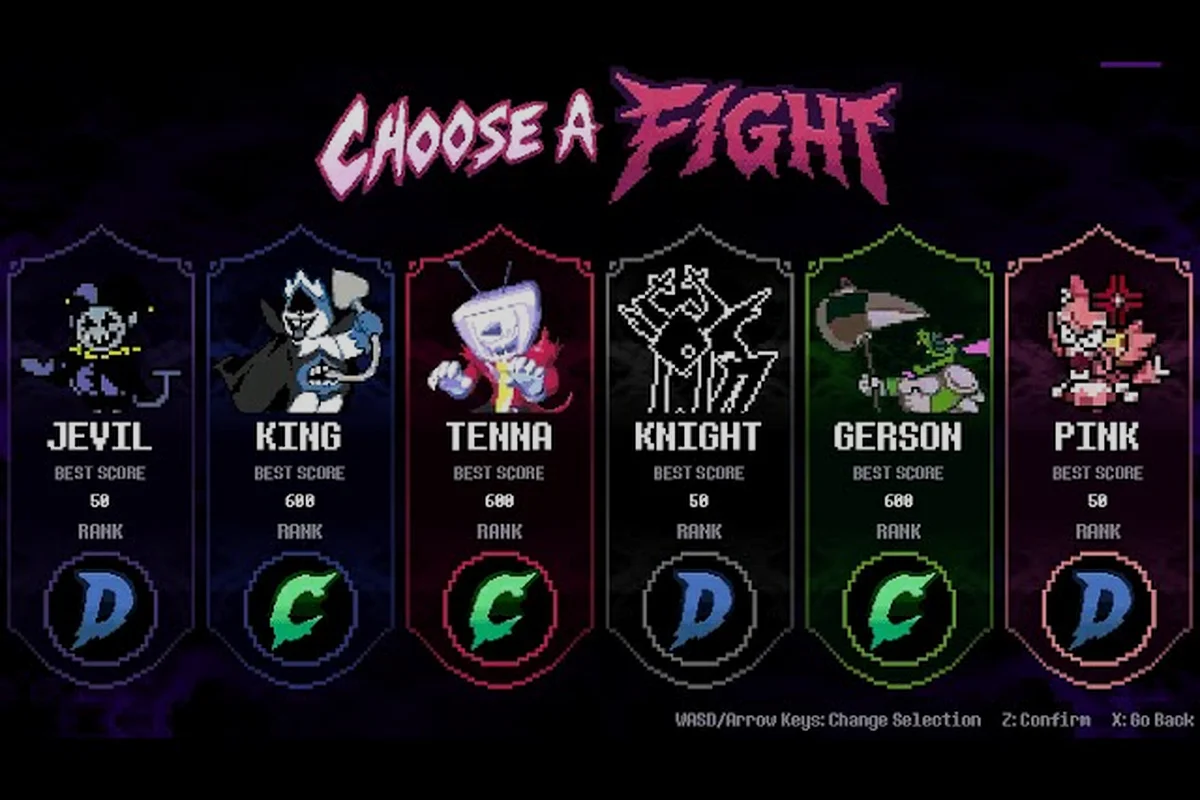
Learning the DELTARUNE Fight all bosses lineup matters because every confirmed encounter demands a different survival habit, and the September 2026 build keeps the roster tight but punishing. The confirmed line-up so far includes Tenna, King, Pink, and Kaizo Knight, each with distinct pressure patterns that punish reactive movement. Community videos show that players who treat every boss as a single dodge test usually stall on the later phases, while players who pre-position before each attack turn clear the same fights with far less frustration.
Confirmed Boss Roster and Difficulty Tiers
The confirmed boss roster in DELTARUNE Fight is deliberately compact, which means the difficulty comes from phase escalation rather than sheer variety. According to community videos, the game runs on three difficulty tier names: Standard, Brutal, and Genocide. Each tier changes how aggressively the same boss behaves, not just how much damage it deals, so a player who learns a boss on Standard still needs to relearn positioning habits on the harder tiers.
| Boss | Theme | Pressure Style | Tier Sensitivity |
|---|---|---|---|
| Tenna | Television | Screen-wide sweeps | High on Brutal and Genocide |
| King | Regal melee | Tracking volleys | Moderate across tiers |
| Pink | Late-game chase | Mixed range pressure | High on Genocide |
| Kaizo Knight | Reinforced knight | Aggressive gap-closing | Highest on Genocide |
The Soul cursor is the heart of every fight, because players steer it through bullet phases while waiting for attack turns. TP, or skill points, builds up as players survive and spend on attacks, which means the defensive half of each fight directly feeds the offensive half. Community videos consistently show that players who burn TP too early on Tenna often lack the burst needed to close out the final phase.
How Difficulty Tiers Reshape the Same Fight
A boss on Standard gives players a readable rhythm, with telegraphed sweeps and a forgiving window between attack turns. Brutal compresses those windows and adds extra projectiles to patterns that were already screen-wide, while Genocide turns every survival turn into a positioning puzzle. Reported by players, the jump from Brutal to Genocide feels larger than the jump from Standard to Brutal, because Genocide punishes even small positioning mistakes with a full restart.
The practical takeaway is that a DELTARUNE Fight boss guide only helps if it accounts for tier behavior. A habit that works on Standard, such as hugging the bottom edge during Tenna's screen-wide sweep, can become a trap on Genocide when tracking volleys force lateral movement. Players who want to clear the full roster should treat each tier as a separate learning pass rather than a simple damage multiplier.
Tenna's Wide Patterns And Pre-Phase Positioning
Tenna is the television-themed boss that most players encounter early, and the fight alternates between survival turns and player attack turns. According to community videos, Tenna leans on wide, screen-spanning patterns that require pre-positioning before a phase starts. The Soul cursor must weave between projectiles while the player waits for TP to build, and the attack turn is the only safe window to spend that TP.
| Phase Habit | What Tenna Demands | Common Mistake |
|---|---|---|
| Pre-position | Move to the safe lane before the sweep starts | Reacting after projectiles spawn |
| TP discipline | Save enough for the final burst | Spending on early chip damage |
| Lateral weave | Shift horizontally through gaps | Backing into a corner |
| Final phase | Hold the center for tracking volleys | Panic-dodging into the sweep |
Players asking how to beat Tenna in DELTARUNE Fight should focus on the rhythm between survival and attack turns. The fight is not a race, because Tenna's health pool is deep enough that early aggression rarely pays off. Instead, the winning habit is to survive the screen-wide sweep, spend TP only when the attack turn opens, and then reset positioning before the next survival turn begins.
Rude Buster and the Final Phase Skip
Rude Buster is the only named attack that appears in community videos, and it matters because players report it can skip the final stretch of Tenna's attack sequence. When the attack turn opens and TP is full, a well-timed Rude Buster can end the phase before the most punishing tracking volley appears. This makes TP discipline even more important, because saving for Rude Buster means surviving longer without spending.
The external community capture Deltarune Fight — All Bosses shows the Tenna fight in full, including how the Soul cursor weaves between projectiles during the high-pressure phase. Watching the raw capture helps players see the pre-positioning habit in action, because the video makes the safe lanes visible before each sweep starts.
King Fight Breakdown and Tracking Volleys
King brings a regal melee style to the DELTARUNE Fight all bosses roster, and the fight leans on tracking volleys that follow the Soul cursor across the arena. Unlike Tenna's screen-wide sweeps, King's pressure is more personal, because the volleys adjust to player movement and punish predictable dodging. Players asking how to beat King in DELTARUNE Fight need to break the habit of dodging in one direction repeatedly.
| King Attack Habit | What It Looks Like | Counter Habit |
|---|---|---|
| Tracking volley | Projectiles curve toward the Soul | Change direction mid-dodge |
| Wide swing | A high-damage arc across the arena | Pre-position to the far edge |
| Pressure gap | A short window between volleys | Spend TP during the gap |
| Final push | Faster volleys with less telegraph | Hold center and weave narrowly |
The fight rewards players who treat each tracking volley as a positioning puzzle rather than a reflex test. Community videos show that the Soul cursor can slip through gaps that look too small, as long as the player commits to a narrow weave instead of a wide panic dodge. The attack turn after each volley is the moment to spend TP, because King's pressure gap is short but reliable.
Why King Punishes Reactive Movement
Reactive movement fails against King because the tracking volleys are designed to catch players who dodge late. When a projectile is already curving toward the Soul, a last-second dash usually moves the cursor into the curve rather than away from it. The winning habit is to read the volley's launch angle early, move to the opposite side of the arena, and then make a small adjustment as the projectiles close in.
The DELTARUNE Fight how to beat King question comes down to patience, because King's health pool is deep and the fight drags if players spend TP inefficiently. Saving TP for the final push, when King's volleys speed up and the telegraph window shrinks, gives players the burst needed to close the fight before the pressure becomes overwhelming.
Pink Fight Breakdown and Mixed Range Pressure
Pink is the late-game boss that mixes ranged pressure with chase behavior, and the fight demands constant repositioning. According to community videos, Pink's patterns combine tracking projectiles with sudden gap-closing moves, which means players cannot camp in one safe lane for long. Players asking how to beat Pink in DELTARUNE Fight should expect to move between three zones: the far edge, the mid arena, and the center.
| Pink Phase Habit | Pressure Type | Survival Response |
|---|---|---|
| Opening volley | Ranged tracking | Weave laterally at mid arena |
| Chase burst | Sudden gap-close | Pre-move to the far edge |
| Mixed pressure | Volleys plus chase | Alternate zones each turn |
| Final phase | Overlapping patterns | Hold center and micro-dodge |
The fight is a test of zone awareness, because Pink punishes players who overcommit to one position. The far edge is safe during the chase burst but dangerous during the opening volley, while the center is safe during the final phase but risky when mixed pressure overlaps. Community videos show that the best players rotate zones before each phase transition, not after.
Zone Rotation as the Core Habit
Zone rotation works because Pink's patterns are telegraphed by the boss's movement before the projectiles spawn. When Pink drifts toward the arena edge, the chase burst is coming, so the player should already be moving to the far side. When Pink holds the center, the opening volley is coming, so the player should be weaving laterally at mid arena. This read-and-rotate loop is the core of the Pink fight.
The DELTARUNE Fight how to beat Pink habit also includes TP spending, because Pink's mixed pressure leaves fewer safe attack turns than Tenna or King. Players should spend TP during the brief gap after the chase burst, when Pink is recovering and the next volley has not yet spawned. Saving TP for the final phase is less important here, because the overlapping patterns leave very few clean attack windows.
Kaizo Knight and the Hardest Tier
Kaizo Knight is the reinforced knight boss that represents the hardest tier in the confirmed line-up so far. According to community videos, Kaizo Knight combines aggressive gap-closing with high-damage swings, and the fight leaves almost no room for passive survival. Players who want to clear the DELTARUNE Fight all bosses roster on Genocide need to master Kaizo Knight's rhythm before attempting the harder tiers.
| Kaizo Knight Habit | What It Punishes | Mastery Response |
|---|---|---|
| Gap-close | Passive survival | Pre-position before the dash |
| High-damage swing | Late dodges | Read the telegraph early |
| Aggressive rhythm | TP hoarding | Spend during the short gap |
| Final phase | Panic movement | Hold a narrow weave lane |
The fight is the most demanding in the roster because Kaizo Knight's gap-closing move forces players to commit to a direction before the dash starts. A late dodge against the high-damage swing usually ends the run, so the winning habit is to read the telegraph, pre-position to the safe side, and then spend TP during the short recovery window. The DELTARUNE Fight how to beat Kaizo Knight guide covers the solo no-hit timing in more detail, but the core habit is the same: commit early and weave narrowly.
Why Kaizo Knight Tests Every Habit at Once
Kaizo Knight is the final exam because it combines the pre-positioning demand of Tenna, the tracking pressure of King, and the zone awareness of Pink into one fight. Players who have not built those habits separately will struggle to keep up with the overlapping demands. The fight also punishes TP hoarding, because the short recovery windows are the only safe moments to spend, and missing them means dragging the fight into the hardest phase with no burst available.
The DELTARUNE Fight all bosses journey ends with Kaizo Knight for most players, because the boss demands mastery of every survival habit the roster teaches. Players who clear Kaizo Knight on Genocide have effectively proven they can handle anything the September 2026 build currently throws at them.
Community-Reported Jevil Sightings and What They Mean
Jevil is a name that appears in community videos, but the confidence is low and the details are unverified. According to community videos, Jevil may exist as a hidden or secret encounter, but the confirmed line-up so far does not include Jevil as a standard boss. Players asking how to beat Jevil in DELTARUNE Fight should treat the question as speculative until more footage appears.
The important distinction is that Jevil is not listed among the confirmed bosses, and no stats, phases, attack names, or rewards are verified for Jevil in this Roblox game. The original Deltarune features Jevil as a secret boss, but that does not confirm the character's presence here. Players should avoid building strategies around unverified encounters and focus on the four confirmed bosses instead.
How to Evaluate Unverified Boss Claims
When a community video claims a new boss, the first check is whether the footage shows the actual DELTARUNE Fight game or a different Deltarune-inspired Roblox project. Several similar games exist, and boss names from the original game often appear in unrelated projects. The second check is whether multiple independent videos show the same encounter, because a single video is not enough to confirm a boss.
The DELTARUNE Fight boss list remains conservative as of the September 2026 build, with four confirmed encounters and no verified secret boss. Players who want to stay current should watch for new community footage, but they should not treat unverified names as part of the roster. The DELTARUNE Fight Secret Boss guide explores the Jevil question in more depth, but the core advice is to verify before committing.
Building a Full Roster Clear Plan
Clearing the DELTARUNE Fight all bosses roster requires a plan that respects tier escalation and habit building. The most efficient order is to learn each boss on Standard first, then push through Brutal, and finally attempt Genocide only after the survival habits feel automatic. Players who jump straight to Genocide usually burn out on Tenna before they ever see Kaizo Knight.
| Clear Plan Step | Focus | Habit to Build |
|---|---|---|
| Tenna on Standard | Pre-positioning | Move before the sweep starts |
| King on Standard | Tracking volleys | Change direction mid-dodge |
| Pink on Standard | Zone rotation | Alternate zones each turn |
| Kaizo Knight on Standard | Gap-close reads | Commit early and weave narrowly |
| Full roster on Brutal | Tier adaptation | Relearn each fight's rhythm |
| Full roster on Genocide | Mastery | Combine all habits under pressure |
The plan works because each boss teaches a specific habit that the next boss builds on. Tenna teaches pre-positioning, King teaches tracking reads, Pink teaches zone rotation, and Kaizo Knight combines all three. Players who follow this order spend less time relearning fights on harder tiers, because the foundational habits are already in place.
Why Tier Escalation Beats Boss Hopping
Boss hopping, or jumping between bosses before mastering any of them, fails because the habits do not transfer cleanly. A player who clears Tenna on Standard and then immediately attempts King on Genocide has not built the tracking-read habit that King demands, so the fight feels impossible. The better path is to clear all four bosses on Standard first, then push the whole roster through Brutal, and only then attempt Genocide.
The DELTARUNE Fight boss guide approach also matters for TP management, because each boss has a different safe window for spending. Tenna rewards saving for the final phase, King rewards spending during the pressure gap, Pink rewards spending after the chase burst, and Kaizo Knight rewards spending during the short recovery window. Learning these windows on Standard makes the harder tiers feel like a natural extension rather than a wall.
Frequently Asked Questions
What is the confirmed DELTARUNE Fight boss list as of the September 2026 build?
The confirmed line-up so far includes Tenna, King, Pink, and Kaizo Knight. These four bosses are verified through community videos and player reports. Jevil appears in a single community video but is not confirmed, so the roster remains conservative until more footage surfaces.
How do I beat Tenna in DELTARUNE Fight?
Pre-position before each screen-wide sweep starts, because reacting after projectiles spawn usually traps the Soul cursor. Save TP for the final phase, and use Rude Buster during the attack turn to skip the last tracking volley. The fight rewards patience over early aggression.
How do I beat King in DELTARUNE Fight?
Break the habit of dodging in one direction, because King's tracking volleys curve toward predictable movement. Read the launch angle early, move to the opposite side, and make small adjustments as projectiles close in. Spend TP during the short pressure gap between volleys.
How do I beat Pink in DELTARUNE Fight?
Rotate between the far edge, mid arena, and center before each phase transition, because Pink's mixed pressure punishes camping in one zone. Spend TP after the chase burst, when Pink is recovering and the next volley has not spawned. The final phase demands narrow micro-dodges at center.
Is Jevil a confirmed boss in DELTARUNE Fight?
No. According to community videos, Jevil may exist as a hidden encounter, but the name appears in only one video and no stats, phases, or rewards are verified. Players should treat Jevil as speculative and focus on the four confirmed bosses until more independent footage appears.