
Tracking the DELTARUNE Fight patch history matters because this Roblox project moves fast, and a single balance pass can quietly rewrite how a boss encounter feels. The developer ItsIsaacIO ships changes without loud announcements, which means players who want to stay competitive need to piece together the update picture from community reports and gameplay captures. This guide consolidates what the September 2026 build actually confirms about the game's development rhythm, version shifts, and the patch landscape so far.
What the Confirmed Patch Landscape Actually Shows
The most important thing to understand about DELTARUNE Fight development is that there is no official patch note feed. The game's Roblox page does not publish a changelog, and the developer has not released a formal version history document. Instead, the community reconstructs what changed by comparing gameplay captures across upload dates and watching how the confirmed boss roster behaves after each quiet update.
This creates a patch landscape that is observable but not officially documented. Players who record their runs on YouTube effectively become the archive, because a DELTARUNE Fight version shift often shows up first as a subtle difference in attack pacing or a new unlock trigger that someone notices mid-stream. The absence of official notes does not mean the game is static; it means the update signal lives in comparative play rather than in a patch log.
| Patch Signal | What Players Actually Observe | Confidence Level |
|---|---|---|
| Boss behavior shift | Attack telegraph timing or pattern density changes between recordings | Medium, based on community video comparison |
| New unlock trigger | A previously locked fight becomes reachable through a different route | Medium, reported by players |
| Difficulty tier adjustment | Standard, Brutal, or Genocide feels more or less punishing after an update | Low to medium, subjective but consistent across reports |
| Stability improvement | Fewer crashes or menu freezes during long boss sessions | Low, anecdotal but repeated |
| Content addition | A new boss or phase appears in the confirmed line-up | High when captured on video |
Because the DELTARUNE Fight developer works solo, the update cadence is irregular. A burst of changes can land in a single week, followed by a quiet stretch where nothing observable shifts. Players who treat every gameplay difference as a confirmed patch risk over-reading normal variance, which is why the community leans on hedged language like "reported by players" or "according to community videos" when discussing what a given DELTARUNE Fight patch actually changed.
How the Confirmed Boss Roster Reveals the Update History
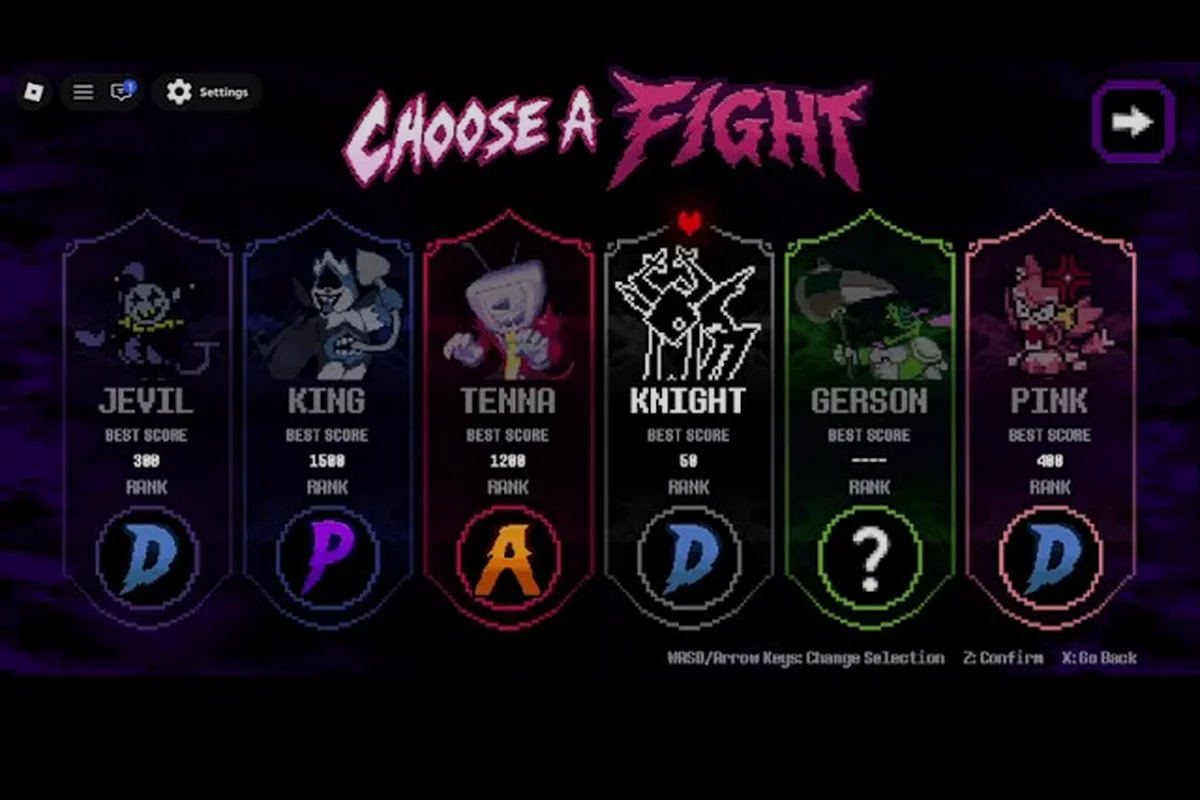
The clearest evidence of DELTARUNE Fight development progress sits in the boss line-up. As of the September 2026 build, the confirmed encounters are Tenna, King, Pink, and Kaizo Knight. Each of these four fights represents a distinct update milestone, because the roster did not arrive all at once. Community reporting suggests that Pink was added later than the initial bosses and had a split rollout, while Kaizo Knight arrived as a difficulty-gated secret fight that extended the endgame.
This staggered roster pattern tells you more about the DELTARUNE Fight roadmap than any official statement could. When a new boss appears, it usually brings a new unlock condition, a fresh attack pattern set, and sometimes a new difficulty interaction. Players who track the DELTARUNE Fight version history through boss additions can reconstruct the development arc: early fights established the core Soul cursor movement and TP economy, while later fights pushed pattern density and survival pressure higher.
| Confirmed Boss | What Its Addition Signals About Development | Community-Reported Trait |
|---|---|---|
| Tenna | Early roster anchor, television-themed encounter | Frequently captured in first-attempt videos |
| King | Core fight rhythm benchmark | Punishes greedy movement |
| Pink | Later addition with split rollout | Arrived after initial roster settled |
| Kaizo Knight | Difficulty-gated secret fight | Highest pressure tier, survival-focused |
The DELTARUNE Fight patch history is therefore not a list of version numbers but a sequence of roster and behavior shifts. If you want to understand where the game is heading, watch which boss gets the most community attention after each quiet update. A surge in Kaizo Knight clear videos, for example, often means the fight was adjusted or a new strategy emerged, even if no official note confirms it.
Reading the ItsIsaacIO Development Style
ItsIsaacIO operates like many solo Roblox developers: the work is iterative, the communication is minimal, and the game itself is the primary changelog. The DELTARUNE Fight developer has not published a formal roadmap, a public Trello board, or a version numbering scheme that players can reference. What exists instead is a pattern of incremental refinement that the community infers from how fights feel across recording sessions.
This development style has practical implications for players. First, you cannot wait for an official "balance patch" announcement before adapting your strategy; you have to notice the shift yourself or catch it in a community video. Second, the absence of version numbers means the DELTARUNE Fight version you are playing is best identified by the build date and the observable boss behavior, not by a patch label. Third, the developer's focus appears to be on fight quality and difficulty tuning rather than on meta systems like shops, party management, or story flags.
The DELTARUNE Fight update log tracks the observable timeline in more detail, but even that reconstruction relies on community video evidence rather than official patch notes. What makes ItsIsaacIO's approach workable for players is that the core combat loop stays stable while individual fights get tuned. You can build muscle memory for the Soul cursor movement and Rude Buster timing without worrying that a patch will delete your fundamentals overnight.
What Community Videos Confirm About Recent Changes
The strongest patch evidence comes from community gameplay captures. The video tenna boss fight (deltarune fights) by ruthra _mbc provides a reference point for how the Tenna encounter behaves in the current build. When newer uploads show the same fight with different attack pacing or a shifted safe-spot pattern, players treat that as a signal that a DELTARUNE Fight patch touched the encounter.
This comparative method is imperfect because player skill and recording quality vary, but it is the most reliable tool available when the developer publishes no notes. The community has learned to distinguish between a genuine balance change and a player simply getting better at the fight. Consistent differences across multiple uploads, especially from different players, carry more weight than a single unusual run.
| Evidence Type | What It Can Confirm | What It Cannot Confirm |
|---|---|---|
| Same boss, multiple uploads | Pattern timing shifts, new attack behaviors | Exact damage or HP values |
| First-attempt captures | Baseline difficulty for new players | Whether a fight was recently nerfed |
| High-tier clear videos | Survival strategy viability on Brutal or Genocide | Official patch intent |
| Side-by-side comparisons | Observable differences between builds | Version numbers or patch dates |
The DELTARUNE Fight roadmap remains unofficial, but the community video archive functions as a living patch history. When you watch a Tenna fight from an early upload next to a current one, you are effectively reading the update log that the developer never wrote. This is why players who care about the meta should keep an eye on new uploads rather than waiting for a formal announcement.
What the September 2026 Build Leaves Unresolved
As of the September 2026 build, several questions about DELTARUNE Fight development remain open. The confirmed boss roster stands at four encounters, but the community continues to speculate about whether more fights will arrive. The difficulty tiers Standard, Brutal, and Genocide are established, but their exact tuning boundaries are not documented. And the developer's long-term plan for the game, including whether it will ever leave its current early state, is unknown.
This uncertainty is not a flaw; it is the natural condition of playing a solo-developed Roblox project. The DELTARUNE Fight patch cadence will likely stay irregular, and the best preparation is to build skills that transfer across fights rather than memorize a single version's quirks. The beginner guide covers the fundamentals that remain stable across patches, which is exactly what you want to anchor your practice routine on while the update landscape shifts around you.
| Open Question | What Players Can Do Now | What Would Resolve It |
|---|---|---|
| Will more bosses arrive? | Master the confirmed four fights | An official roster announcement or new video evidence |
| Are difficulty tiers final? | Practice on the hardest tier you can clear | A documented tier adjustment |
| Will official patch notes appear? | Track community video comparisons | A changelog on the Roblox page |
| Is the game still in active development? | Watch for new uploads and behavior shifts | A developer statement or major content drop |
The DELTARUNE Fight version you play today may feel different in a month, and that is part of the appeal for players who enjoy adapting to a moving target. The absence of official patch notes forces a more observational playstyle, where you read the game itself as the primary source of truth.
Practical Habits for Tracking Patches Without Official Notes
Since the DELTARUNE Fight developer does not publish a changelog, you need a personal system for noticing when the game shifts. The most effective approach combines three habits: recording your own runs, comparing against community uploads, and keeping a lightweight personal log of what feels different after each play session. This turns patch tracking from a passive wait into an active observation practice.
Start by establishing a baseline. Run the same confirmed boss on the same difficulty tier several times and note how the fight feels: attack telegraph timing, safe-spot reliability, and how much TP you need to bank for key moments. When something changes, you will notice it faster because you have a clear reference point. The pro tips guide helps you build the consistency that makes patch detection possible, because a player who clears erratically cannot tell the difference between a balance change and their own variance.
-
Record your own clears — a personal video archive gives you a direct comparison point for future sessions
-
Watch new community uploads — fresh captures of the same boss reveal behavior shifts across builds
-
Log subjective difficulty — note when a fight feels harder or easier on the same tier, even without numbers
-
Check the confirmed roster — a new boss or unlock trigger is the clearest patch signal available
-
Hedge your conclusions — treat every observed difference as a report, not a confirmed patch note
This observational approach aligns with how the DELTARUNE Fight roadmap actually works: it emerges from accumulated player reports rather than from official announcements. The players who stay ahead of the meta are the ones who treat their own gameplay as patch data and cross-reference it against the community archive.
Frequently Asked Questions
Who is the DELTARUNE Fight developer?
The game is developed by ItsIsaacIO, a solo Roblox creator who has not published a formal roadmap or changelog. The development style is iterative and quiet, with updates inferred from gameplay changes rather than official notes. Players track the game's progress through community video comparisons and observable boss behavior shifts.
How do I know which DELTARUNE Fight version I am playing?
There is no official version numbering scheme, so players identify the build by the September 2026 date and the observable boss roster. The confirmed encounters are Tenna, King, Pink, and Kaizo Knight. If a new boss appears or an existing fight behaves differently, you are likely on a newer build.
Does DELTARUNE Fight have official patch notes?
No, the game does not publish a changelog on its Roblox page. The DELTARUNE Fight patch history is reconstructed by the community through video comparisons and player reports. This means patch information is always hedged with phrases like "reported by players" or "according to community videos" rather than stated as confirmed fact.
What is the DELTARUNE Fight roadmap for future content?
There is no official roadmap. The confirmed boss roster stands at four encounters as of the September 2026 build, and the developer has not announced additional fights or a full release timeline. Players watch for new community uploads and behavior shifts as the only reliable signal of ongoing development.
Is DELTARUNE Fight still being updated in 2026?
Yes, the game shows signs of active development through staggered boss additions and observable balance tuning, even without official notes. The Pink boss had a split rollout, and Kaizo Knight arrived as a difficulty-gated secret fight, which suggests the developer continues to expand the roster and tune difficulty tiers.